Stop paying for leads that don’t lease
Most multifamily ad accounts are built to buy leads. Leads are cheap and easy to count. Leases fill units. How to measure the second one, and how to buy more of it.


- Cost per lead tells you what an inquiry cost. Cost per lease tells you whether the spend worked.
- Ad platforms optimize toward whatever you count as a conversion. Count form fills and you get more form fills.
- Send tours and signed leases back to Google, and close the gap between lead and tour. Mark-Taylor’s lead-to-tour conversion rose to 18.1% from 7.3% after it moved leasing onto Union.
Ask a multifamily marketer what a lead cost last month. The answer takes a few seconds. It is on the invoice.
Ask how many of last month’s leads signed a lease. That answer usually takes a report, a spreadsheet and a guess.
The gap between those two answers is where marketing budgets leak. Leads are easy to buy and easy to count. Leases fill units. When reporting stops at the lead, the budget, the agency and the ad platform all optimize for the wrong thing.
Cost per lead measures the cheap part
Cost per lead divides marketing spend by inquiries. Cost per lease divides the same spend by signed leases.
The spend is the same in both. Only the second number tells you whether the money worked.
Here is how the two can disagree. Two sources each cost $5,000 in a month. Source A brings 250 leads and 5 signed leases. Source B brings 100 leads and 10 signed leases.
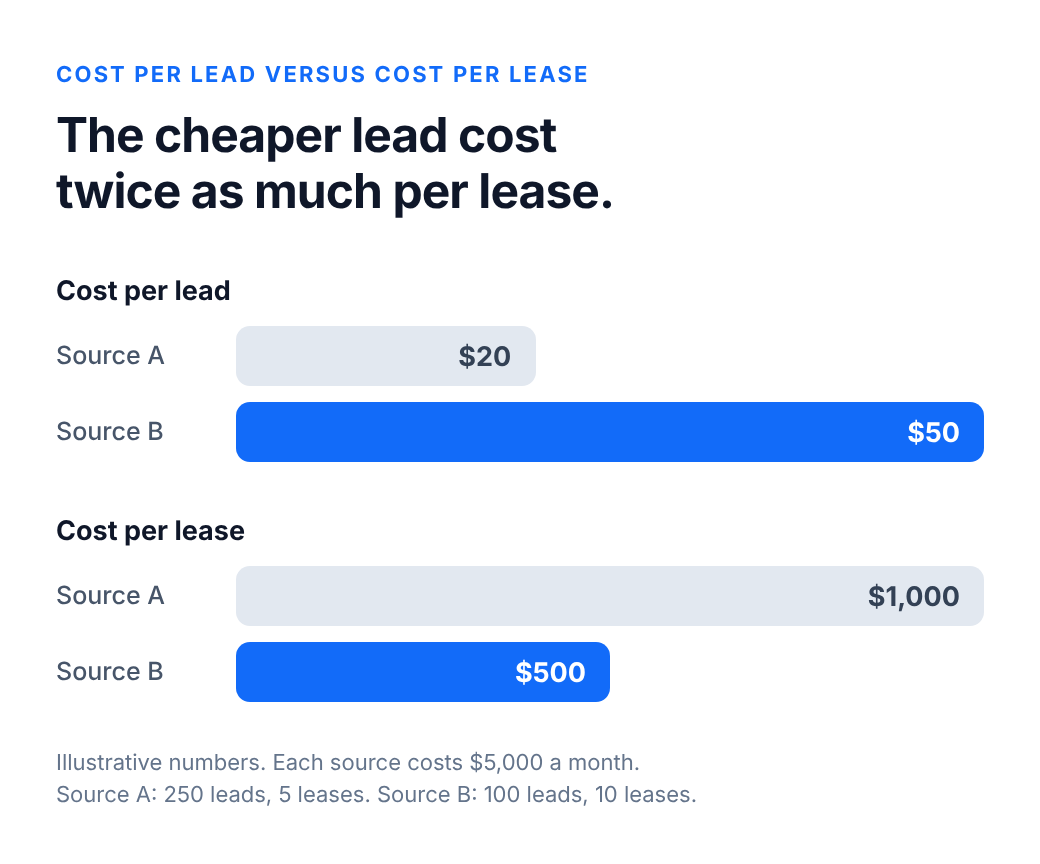
On a cost-per-lead report, Source A wins by $30 a lead. On a cost-per-lease report, Source B is twice as efficient. Cut by the first report and you cut the source that fills units.
Cheap leads cost more in a second way. Every lead that will never lease still takes a call, a follow-up or a tour slot from your leasing team.
Ad platforms learn from your conversion
Google’s Smart Bidding optimizes toward the conversion you set. In most multifamily ad accounts, that conversion is a form fill or a tap on the phone number. So the algorithm gets very good at finding people who fill out forms. It cannot see who toured, who applied or who signed.
Google built a way to close that gap. Offline conversion imports let you send outcomes from your CRM back to the ad click or call that started them. Google’s lead goals now separate a qualified lead from a converted lead, so bidding can optimize toward deeper steps in your funnel instead of lead volume.
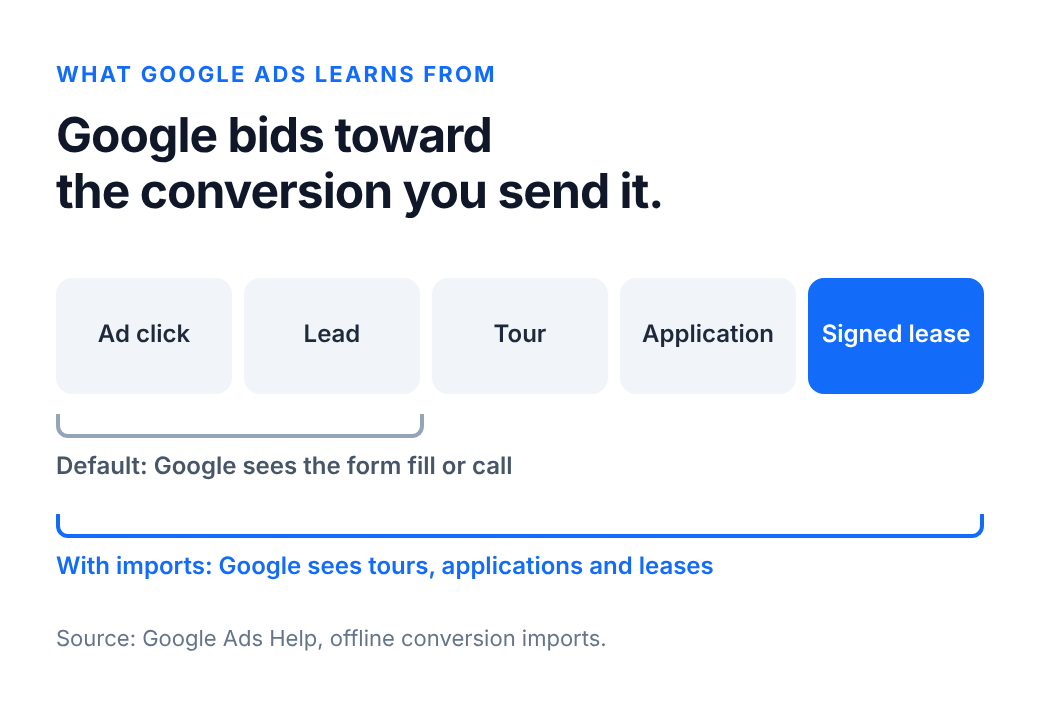
For an apartment community, the deeper steps are clear: a tour, an application, a signed lease.
The data you send matters too. Google reports that advertisers who sent first-party data, such as email addresses and phone numbers, with their imported conversions saw a median 10% increase in conversions over standard imports.
The other leak: lead to tour
Better targeting only pays if someone answers. A prospect who waits until morning for a reply has had all night to call the community down the street.
After Mark-Taylor Residential moved leasing onto Union, with Union’s voice AI answering prospect calls, its lead-to-tour conversion rose to 18.1% from 7.3%.
Measure the response alongside the source. A source can look expensive because its leads waited, not because they were bad.
Five changes before 2027 budgets close
- Report cost per lease by source, every month. Divide each source’s spend by the signed leases it produced in the same period. Keep cost per lead as an early warning, not a verdict.
- Make the lease the conversion. Send tours and signed leases from your CRM back to Google. Optimize toward the deepest stage that has enough volume, and keep form fills for reporting.
- Keep the source on the record. Attribution breaks when the lead source lives in one system and the lease lives in another. Capture the click ID and the source on the first record, and carry them through to the lease.
- Track response next to cost per lease. Report speed to first reply and answered-call rate by source. Fix the response before you cut the source.
- Judge new sources on leases. Give a new source time to turn its leads into signed leases before you call it a winner or a loser.
Where Union fits
Union is the AI-powered CRM for multifamily. Websites, the CRM and the AI share one renter record. The lead source and the signed lease live in the same place, so cost per lease is a report, not a project.
- Attribution to the lease. Union marketing carries each lead’s source to the signed lease, so you can see cost per lease by source, agent, property and campaign.
- Every call answered. Union’s voice AI answers prospect calls, books tours and hands off to your team when a prospect wants a person.
- One record for people and AI. The AI CRM keeps every lead, conversation and lease together, so the leasing team and the AI work from the same history.
Careena Daly, Union’s VP of Customer Success, is leading a roundtable on this topic at Cadence Fall Connect on November 5. If you are there, bring the lead source you have doubts about.
Common questions about cost per lease
What is cost per lease in multifamily?
Cost per lease is marketing spend divided by signed leases over the same period. Calculate it by source to see which channels fill units.
Is cost per lead still useful?
Yes, as an early signal. It shows whether a source is producing inquiries before leases have had time to sign. It should not decide where the budget goes.
What is a good cost per lease?
It depends on the market, the season and whether the property is in lease-up. Compare each source against your own trend and against the rest of your mix, not against a national average.
How do you send signed leases back to Google Ads?
Store the ad click ID or the prospect’s contact details with the lead in your CRM. When the lease signs, upload it to Google Ads as a converted lead. Google recommends enhanced conversions for leads for advertisers just starting with imports.
Why can cheap leads raise cost per lease?
Leads that never lease still take calls, follow-ups and tour slots. They add leasing time without adding leases, so the cost per signed lease goes up.
See cost per lease by source on your own portfolio. Book a demo.
Sources: Google Ads Help, About offline conversion imports. Google Ads Help, About qualified leads and converted leads. Union, Mark-Taylor customer story.