Centralizing Teams Is Only Half the Equation
Multifamily is changing where work happens. The bigger opportunity is changing how the work gets done.
Centralization is no longer an edge-case operating model in multifamily.
According to Multifamily Executive’s 2026 NOI & Operations Survey, seven out of 10 large operators have adopted centralized or hybrid staffing models. Among small operators, that number is only one in five.
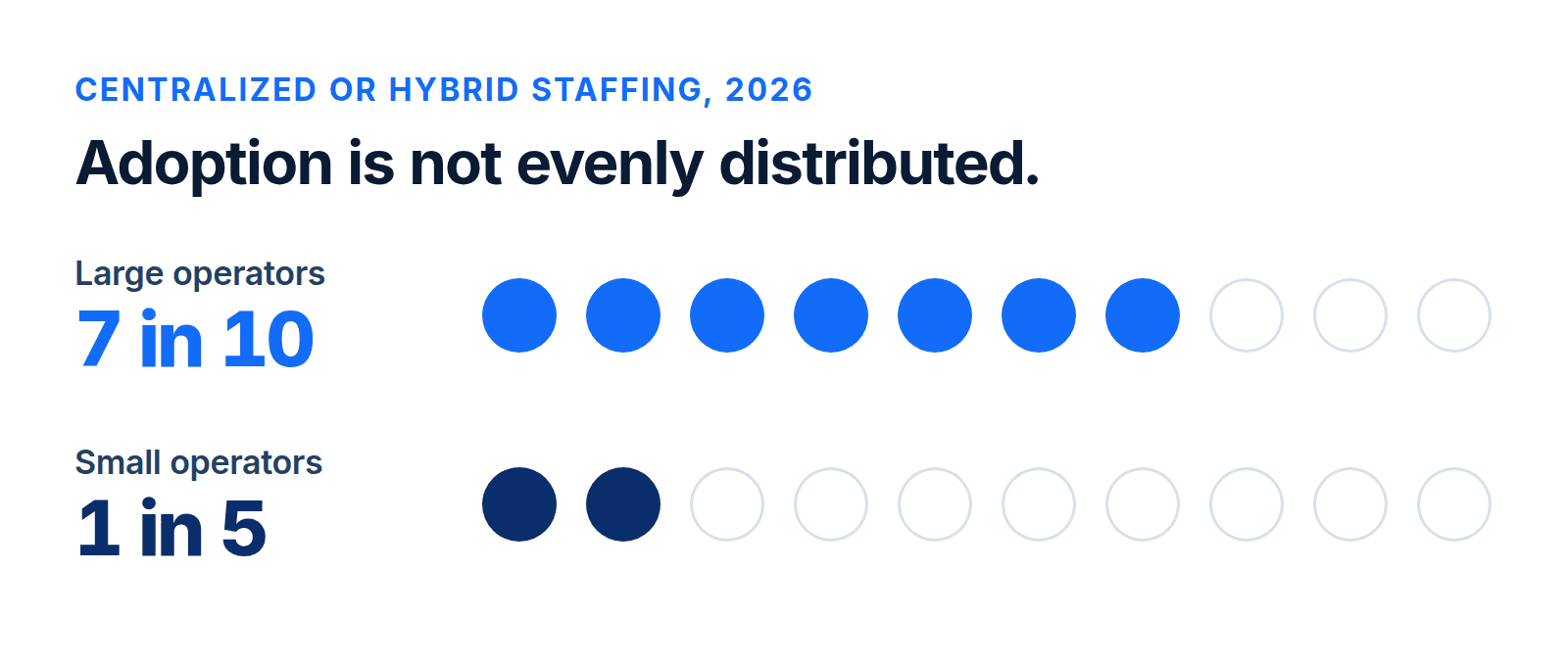
The reason is straightforward. Owners and operators are under pressure to protect NOI, control expenses and get more leverage from the teams they already have. In the same survey, 35% ranked cost control and expense management as their top priority for the next three years.
But moving people from individual properties into a centralized office does not automatically create efficiency.
If the work is still fragmented across systems, inboxes, property teams and disconnected records, you have not really centralized the operation.
You have centralized the people.
There is a difference.
Centralization should change the operating model
For years, multifamily technology was designed around the property.
Each community had its team. Its leads. Its leasing activity. Its resident interactions. And often, its own way of getting work done.
Centralization changes that structure.
A leasing specialist might now support multiple communities. An above-property team may handle conversations that previously stayed onsite. AI may answer a prospect at 10 p.m., while a centralized agent continues the conversation the next morning and an onsite team eventually welcomes that same person as a resident.
That model only works when everyone is operating with the same context.
Otherwise, every handoff creates another opportunity for something to get lost.
The renter has to repeat themselves. The centralized agent has to hunt for information. The onsite team cannot see what happened before the prospect arrived. AI knows one piece of the conversation while the CRM knows another.
You have moved the work, but you have not removed the friction.
The technology has to centralize with the team
This is where the conversation around centralization needs to evolve.
The objective should not simply be: how many roles can we centralize?
It should be: how much of the renter journey can operate as one connected system?
Multifamily Executive reported earlier this year that operators are increasingly looking toward integrated technology, automation and fewer handoffs as they rethink centralized operations and their technology stacks.
That matters because centralization creates more value when information can move as easily as people do.
A prospect should not belong to one leasing office. A conversation should not belong to one employee. And AI should not operate from a separate version of the renter than the people using the CRM.
The renter should have one continuous record that follows them from the first marketing interaction through leasing and into residency.
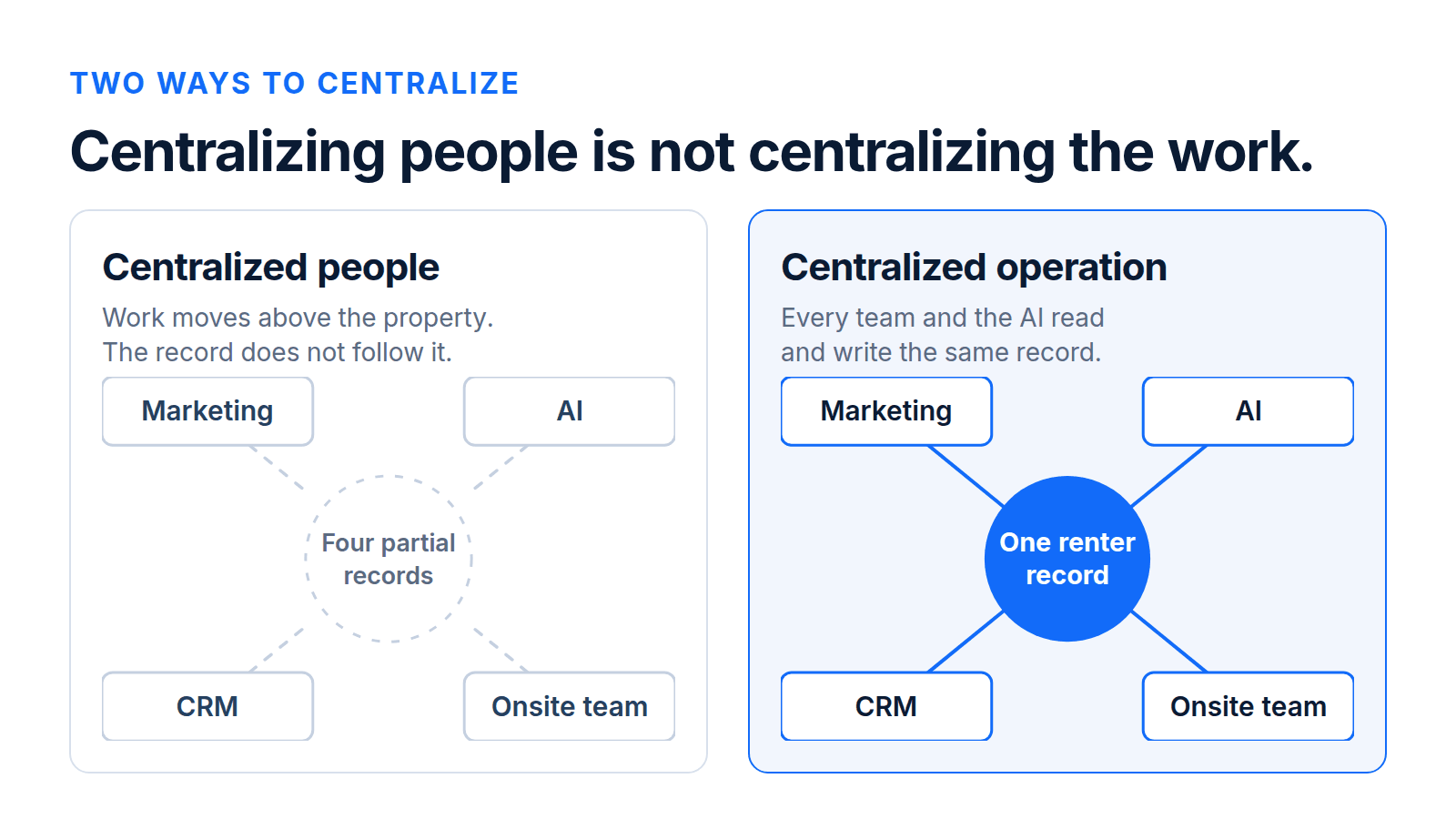
That is the operating model Union is built around.
One renter. One record. One operation.
Union connects marketing, CRM, AI, leasing and resident operations around the same renter journey.
That changes what a centralized team can actually do.
An AI conversation does not have to disappear when a human takes over. A centralized leasing agent does not have to start from scratch when someone calls about a different property. An onsite team does not have to reconstruct what happened during the leasing process.
Above-property leaders can see the work happening across the portfolio instead of piecing together activity property by property. And specialized teams can support multiple communities without creating a maze of handoffs behind the scenes.
The goal is not centralization for the sake of centralization.
It is leverage.
What that looks like in practice
One Union customer ran four properties with four separate leasing offices and 12 leasing agents. Every office replicated the same staffing structure as the one next door.
By centralizing leasing into a single office and using Union to connect the work across those properties, the organization moved to four specialized agents supporting the same four communities.
The important part is not simply that fewer people were needed.
The operating model changed.
Instead of replicating the same structure at every property, the organization could specialize work, share resources across communities and give both centralized and onsite teams access to the same renter record.
Technology became leverage instead of another layer of overhead. Mark-Taylor has centralized 35 communities on Union on the same principle.
Centralization without connection has a ceiling
The industry is already seeing efficiency improvements, but there is still a large gap between incremental improvement and fundamental operating change.
Half of respondents in Multifamily Executive’s 2026 survey said operational efficiency had improved over the past two years. Only 16% described those improvements as significant.
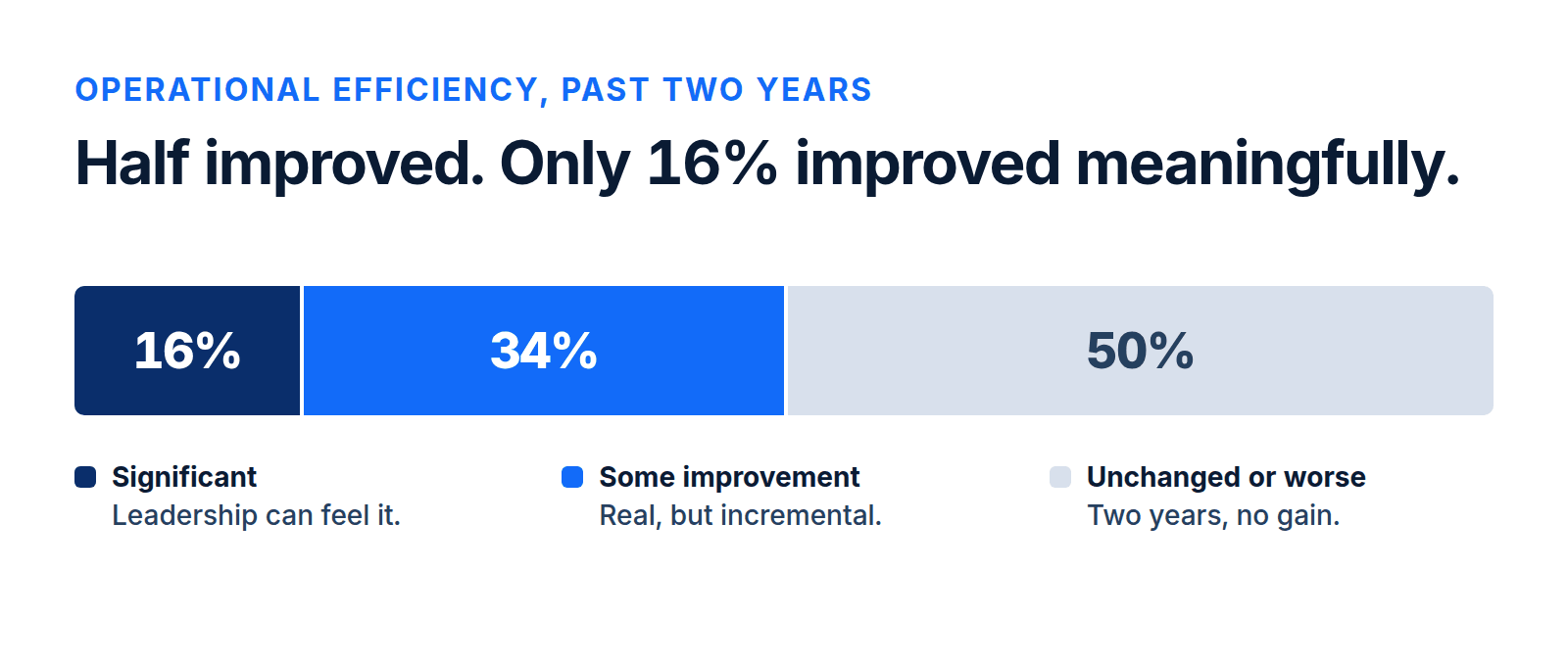
That is an important distinction.
Centralizing a few tasks may save time. Adding AI may automate conversations. Consolidating a few vendors may reduce cost.
But the largest opportunity comes when those changes work together.
For executive teams evaluating centralization, the questions become:
- Can a centralized employee pick up any renter interaction without starting over?
- Does AI operate from the same information as leasing and onsite teams?
- Can work move across properties without creating additional handoffs?
- Can the technology stack shrink as the operating model becomes more centralized?
- Can the financial impact be measured in capacity, conversion, revenue or operating expense?
Those are harder questions than simply asking whether a function can be moved off-site.
They are also where the ROI becomes much more meaningful.
The next phase of centralization
Multifamily does not need to choose between centralized efficiency and a strong renter experience.
The technology should make it possible to have both.
Centralized teams can create specialization. AI can create capacity. Connected data can preserve context. And onsite teams can spend more of their time on the moments where being onsite actually matters.
But only when the underlying systems work together.
Centralization changes where the work happens. Union changes how the work gets done.
Common questions about centralization in multifamily
What does centralization mean in multifamily?
Centralization moves work that used to happen at each property, such as answering leasing calls, scheduling tours, processing applications and handling renewals, into a shared above-property team that supports several communities at once. A hybrid model keeps part of that work onsite and shares the rest.
How many multifamily operators have centralized?
Seven in 10 large operators have adopted a centralized or hybrid staffing model, according to Multifamily Executive’s 2026 NOI & Operations Survey. Among small operators the figure is one in five.
Does centralizing staff actually reduce operating costs?
It can, but only when the work is connected as well as the people. If every team still works from its own record, centralization adds handoffs rather than removing them. Half of operators in the same survey reported no efficiency gain at all over the past two years.
What has to be true for centralization to work?
One renter record that marketing, AI, the centralized team and the onsite team all read and write. When the record is shared, a prospect who starts with AI at 10 p.m. and speaks to a centralized agent the next morning never has to repeat themselves, and the onsite team can see the full history when that person moves in.
What is the difference between centralizing people and centralizing the operation?
Centralizing people changes where the work happens. Centralizing the operation changes how the work gets done, by putting marketing, AI, the CRM, the centralized team and the onsite team on the same renter record so nothing restarts at a handoff.
Source: Multifamily Executive, 2026 NOI & Operations Survey Report, based on responses from more than 100 multifamily executives across portfolio sizes.